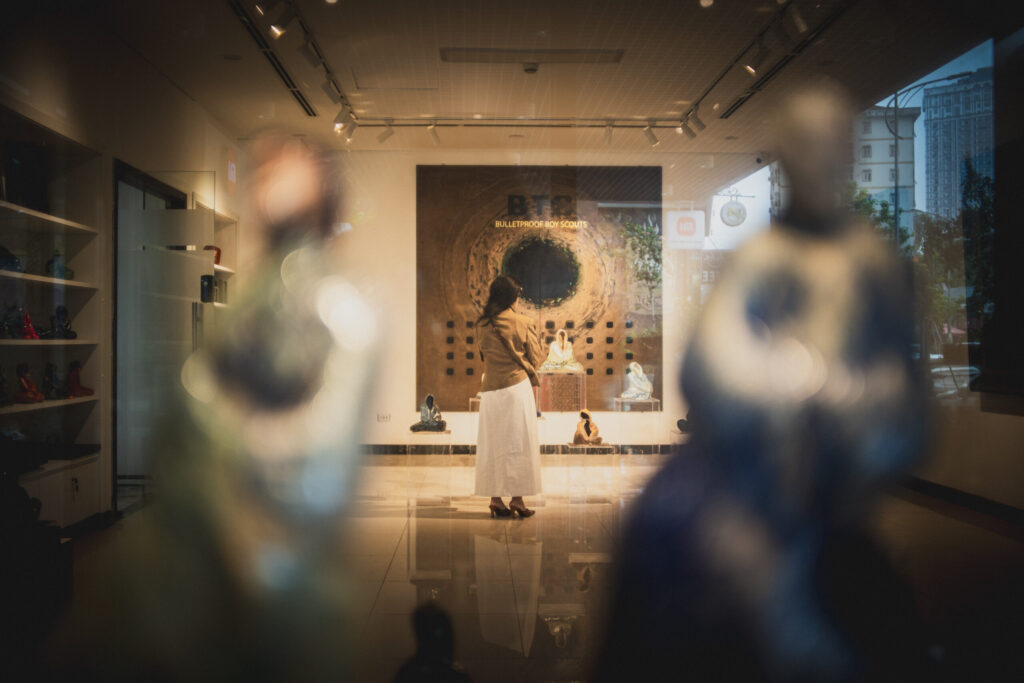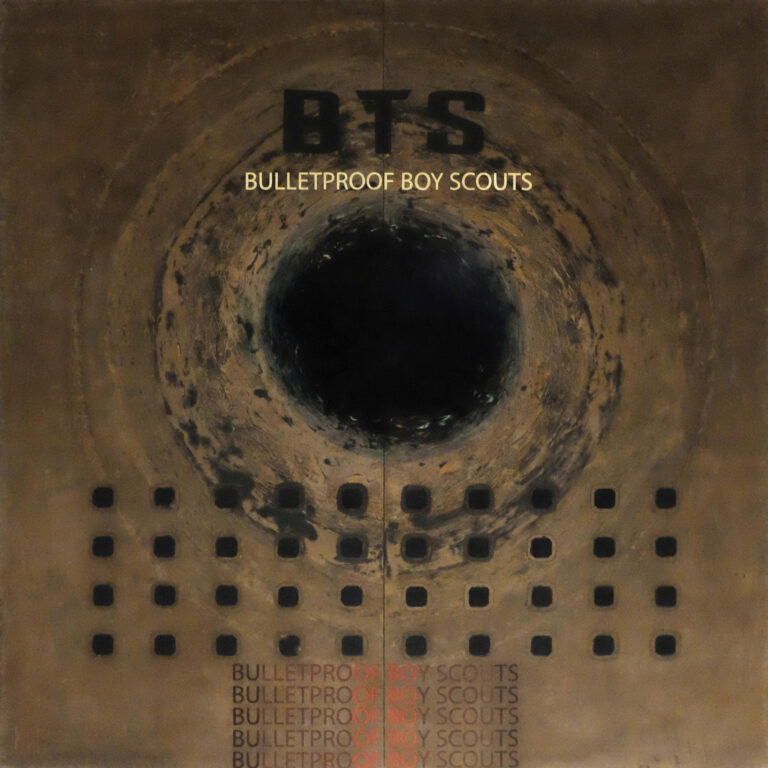
The artwork Bulletproof Boy Scouts draws on the symbolic weight of its title to explore themes of vulnerability, protection, and resistance in contemporary society. While the name directly references the world-famous South Korean music group BTS, an abbreviation of Bangtan Sonyeondan (방탄소년단), meaning Bulletproof Boy Scouts, the work extends beyond homage to become a broader reflection on youth, identity, and the mechanisms we build to survive social pressure.
At the heart of the artwork lies the idea of being “bulletproof” not as an image of invincibility, but as a fragile, necessary form of armour. The “bullets” evoked are invisible yet pervasive: academic expectations, appearance norms, gender roles, productivity demands, and the fear of falling outside accepted standards. These pressures shape bodies and behaviours from an early age, often leaving little room for doubt, softness, or failure. The artwork visualises this tension between exposure and defence, suggesting that resilience is not innate, but learned.
The reference to scouting introduces another layer of meaning. Traditionally associated with discipline, moral codes, and the preparation of youth for adulthood, the figure of the “boy scout” here is both empowered and constrained. In Bulletproof Boy Scouts, this archetype is subtly destabilised, questioning what it means to be prepared, obedient, or exemplary in a world that continuously shifts its expectations. The work invites viewers to consider how ideals of strength and success are transmitted, internalised, and sometimes resisted.
Finally, the alternative meaning of BTS, Beyond The Scene, resonates strongly within the artwork. It gestures toward movement, growth, and the possibility of stepping outside prescribed narratives. Bulletproof Boy Scouts thus becomes a space of negotiation: between protection and exposure, conformity and emancipation, inherited frameworks and imagined futures. Rather than offering a fixed statement, the artwork leaves these tensions open, allowing viewers to project their own experiences of pressure, defence, and becoming.